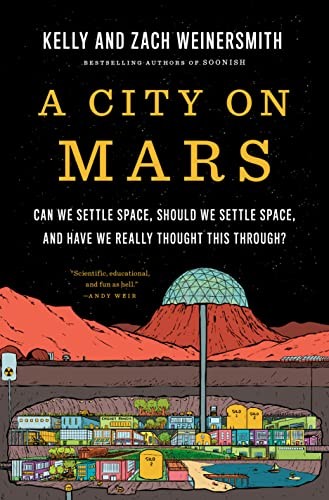
Earth is not well. The promise of starting life anew somewhere far, far away - no climate change, no war, no Twitter - beckons, and settling the stars finally seems within our grasp. Or is it? Bestselling authors Kelly and Zach Weinersmith set out to write the essential guide to a glorious future of space settlements, but after years of original research, and interviews with leading space scientists, engineers and legal experts, they aren't so sure it's a good idea. Space tech and space business are progressing fast, but we lack the deep knowledge needed to have space-kids, build space-farms and create space nations in a way that doesn't spark conflict back home. In a world hurtling toward human expansion into space, A City on Mars investigates whether the dream of new worlds won't create a nightmare, both for settlers and the people they leave behind.
With deep expertise, …
Earth is not well. The promise of starting life anew somewhere far, far away - no climate change, no war, no Twitter - beckons, and settling the stars finally seems within our grasp. Or is it? Bestselling authors Kelly and Zach Weinersmith set out to write the essential guide to a glorious future of space settlements, but after years of original research, and interviews with leading space scientists, engineers and legal experts, they aren't so sure it's a good idea. Space tech and space business are progressing fast, but we lack the deep knowledge needed to have space-kids, build space-farms and create space nations in a way that doesn't spark conflict back home. In a world hurtling toward human expansion into space, A City on Mars investigates whether the dream of new worlds won't create a nightmare, both for settlers and the people they leave behind.
With deep expertise, a winning sense of humour and art from the beloved creator of Saturday Morning Breakfast Cereal, the Weinersmiths investigate perhaps the biggest questions humanity will ever ask itself - whether and how to become multiplanetary.
I love the Weinersmiths' style of writing and the comics. I laughed aloud several times as I listened to this book. The lighthearted tone of the book makes it easy to digest the heavy implications of the concepts.
I also really connected with what might be considered the negative conclusions regarding the large variety of systems that require consideration for colonizing space or any planet in our solar system.
I often find that while excited about ideas brought to me at work, I'm perceived as negative for asking the questions that need to be thought through before implementation in order to prevent catastrophe. This book validates that approach.
If you're looking for a thought-provoking, yet humorous, exploration of the challenges of colonizing Mars, this is the book for you.
I love the Weinersmiths' style of writing and the comics. I laughed aloud several times as I listened to this book. The lighthearted tone of the book makes it easy to digest the heavy implications of the concepts.
I also really connected with what might be considered the negative conclusions regarding the large variety of systems that require consideration for colonizing space or any planet in our solar system.
I often find that while excited about ideas brought to me at work, I'm perceived as negative for asking the questions that need to be thought through before implementation in order to prevent catastrophe. This book validates that approach.
If you're looking for a thought-provoking, yet humorous, exploration of the challenges of colonizing Mars, this is the book for you.
Accessible and intricately researched, with scattered humor to keep the reader's interest.
Getting to space is the easy part. Staying there is going to be a lot more complicated than anyone wants to believe. There are plenty of established tropes in science-fiction and among serious space enthusiasts, but a lot of them have major gaps in them when you start pressing for details. What happens to a fetus in microgravity? Can you scrape together enough soil nutrients to supply agriculture for a whole Mars city, or do you need to constantly import fertilizer from Earth? How do you make sure you have enough medical supplies on-hand?
The authors wanted to write about what we know about space settlement. But it turns out it's a really good primer for what we don't know and need to research before we can get serious.
Accessible and intricately researched, with scattered humor to keep the reader's interest.
Getting to space is the easy part. Staying there is going to be a lot more complicated than anyone wants to believe. There are plenty of established tropes in science-fiction and among serious space enthusiasts, but a lot of them have major gaps in them when you start pressing for details. What happens to a fetus in microgravity? Can you scrape together enough soil nutrients to supply agriculture for a whole Mars city, or do you need to constantly import fertilizer from Earth? How do you make sure you have enough medical supplies on-hand?
The authors wanted to write about what we know about space settlement. But it turns out it's a really good primer for what we don't know and need to research before we can get serious.
It's also an interesting companion to Under Alien Skies, which takes the approach of "assuming we're able to work out the details, this is what it would be like there." And, well, we have a lot more details to work out.